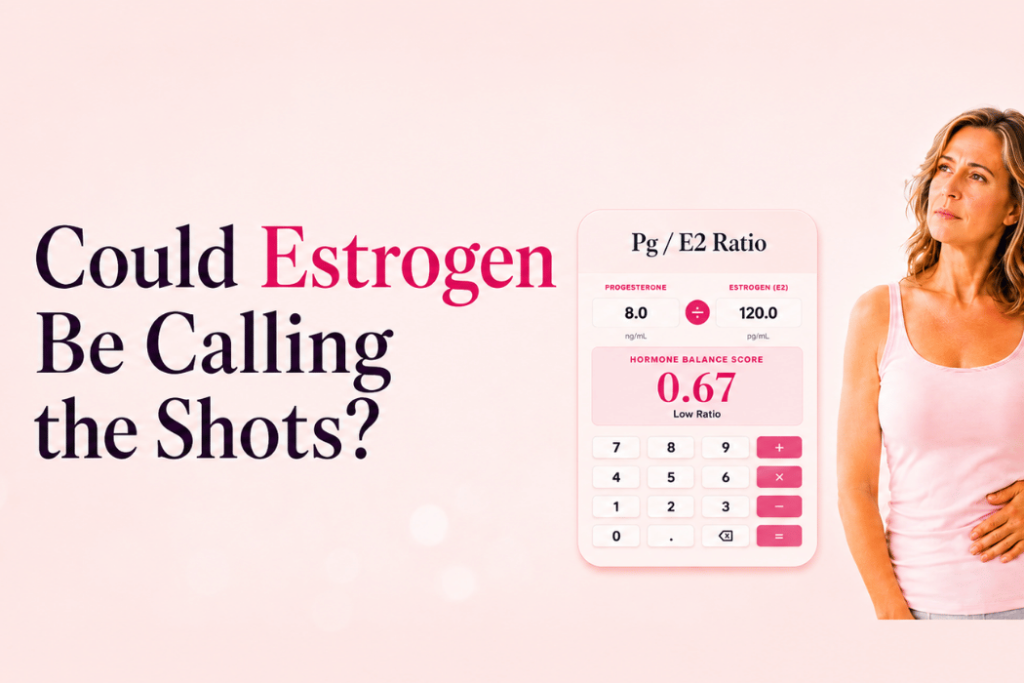
Your hormones should work like a team, not a tug-of-war. But sometimes estrogen gets a little too loud. When estrogen is running the show, your body may feel like it has gone completely off-script. You may feel bloated, moody, tired, puffy, anxious, heavy, or just not like yourself.
And here is the part that makes me crazy: too many women are told, “Your labs are normal,” or “This is just part of getting older.” That is not good enough. Common does not mean normal. Feeling dismissed is not a treatment plan.
If you are wondering whether estrogen dominance may be part of your hormone story, you can start with our simple estrogen dominance calculator: CLICK HERE
Estrogen dominance means estrogen may be too strong compared to progesterone. That does not always mean estrogen is sky-high. Sometimes estrogen is in range, but progesterone is too low to balance it. That imbalance can create symptoms that feel confusing, frustrating, and sometimes downright unfair.
Think of estrogen like the builder hormone. It builds, grows, stimulates, and activates. Progesterone is more like the calm-the-room-down hormone. It helps balance, soothe, protect, and steady the system. You need both. But when estrogen keeps pushing and progesterone is not keeping up, the body may start waving a hormone red flag.
Estrogen dominance can look different for every woman. Some women feel it mostly in their mood. Some feel it in their periods. Some feel it in their weight, breasts, sleep, energy, or inflammation. Symptoms may include heavy periods, irregular cycles, breast tenderness, PMS, mood swings, anxiety, irritability, bloating, puffiness, headaches before your period, trouble sleeping, brain fog, fatigue, low libido, fibroids, endometriosis symptoms, PCOS patterns, spotting, or feeling inflamed.
If you read that list and thought, “Well, that sounds like my entire personality lately,” take a breath. You are not crazy. Your body may be trying to get your attention.
Now let’s be very clear: estrogen is not the enemy. Estrogen is powerful and important. It supports your brain, bones, heart, skin, mood, metabolism, vaginal health, and menstrual cycle. Low estrogen can also cause major symptoms, including hot flashes, night sweats, vaginal dryness, painful sex, bladder changes, sleep problems, joint pain, and brain fog.
The goal is not to hate estrogen. The goal is balance.
Hormones are like an orchestra. Estrogen may be playing the violin, but progesterone helps keep the rhythm steady. Testosterone, thyroid, cortisol, insulin, and nutrients all have parts too. When one section gets too loud, the whole song sounds off. That is what hormone imbalance can feel like.
Progesterone does not get enough attention, and honestly, that is a problem. Progesterone helps balance estrogen’s effects in the body. It also supports sleep, mood, cycle rhythm, and the uterine lining. In perimenopause, progesterone often starts changing before estrogen fully drops. That is one reason women in their 40s may still have periods but feel completely different.
You can still be cycling and still have hormone imbalance. You can still be told “everything looks normal” and still feel awful. That is why symptom patterns matter. That is also why looking at progesterone and estrogen together can be helpful.
The estrogen dominance calculator looks at the relationship between progesterone and estradiol. Estradiol is one form of estrogen. The calculator looks at what is often called the Pg/E2 ratio, which means progesterone compared to estradiol. This ratio may help you understand whether progesterone is keeping up with estrogen.
This is not a diagnosis. It is a clue. And when it comes to hormones, clues matter. Most women do not need another person shrugging and saying, “Everything looks fine.” They need someone to connect the dots.
If you have recent hormone numbers, you can use the calculator now. Go here to check your ratio: https://estrogendominancecalculator.com.
You will enter your progesterone and estrogen numbers, and the calculator will help you see whether your ratio may suggest an estrogen-dominant pattern. It is a simple first step. It does not replace medical care, but it can help you understand your body better. And that is where real empowerment starts.
If you do not know your progesterone or estrogen levels, that may be your next step. Because guessing gets expensive. Testing gives direction.
At Hormone Bliss, we use at-home hormone testing kits to help women get real information about what may be happening in their body. No begging. No gaslighting. No “come back when it gets worse.” The goal is simple: test, understand, and create a plan.
Your symptoms are not random. They are messages. The problem is, most women were never taught how to read them.
The estrogen dominance calculator may be helpful if you are dealing with PMS, heavy periods, mood swings, bloating, breast tenderness, irregular cycles, perimenopause symptoms, brain fog, weight gain, low libido, fatigue, fibroids, endometriosis, PCOS, sleep changes, or feeling dismissed by your doctor.
And estrogen dominance is not just a menopause issue. Younger women can struggle with it too. Women in their 20s and 30s may see estrogen-dominant patterns with PCOS, endometriosis, irregular ovulation, fertility struggles, painful periods, and PMS. Women in their 40s and 50s may notice symptoms as progesterone shifts during perimenopause.
Different ages. Different symptoms. Same need: better answers.
A calculator can be helpful, but it should never replace medical evaluation. Please talk to a qualified medical provider if you have very heavy bleeding, bleeding after menopause, bleeding after sex, new or severe pelvic pain, rapidly worsening symptoms, severe depression or anxiety, chest pain, shortness of breath, fainting, or sudden neurological symptoms.
Bleeding after menopause should always be checked. Do not try to “balance hormones” around a red flag. That is not empowerment. That is guessing with consequences.
The truth is, the health system often misses women’s hormone symptoms. Women are told they are stressed, aging, anxious, overweight, or “just hormonal.” They are handed birth control, antidepressants, or vague advice without anyone asking why the symptoms started in the first place.
Sometimes those tools may help the right person. But too often, no one connects the dots. That is the problem. You deserve more than a bandage slapped over a biology problem.
Estrogen dominance is not a personality flaw. You are not lazy. You are not dramatic. You are not broken. And you are not supposed to just suffer through it.
Hormone symptoms are signals. Your body is not betraying you. It is trying to get your attention.
If you are wondering whether estrogen dominance may be part of your story, start here: https://estrogendominancecalculator.com.
Check your hormone pattern. See what your progesterone-to-estrogen ratio may suggest. And if you do not have current hormone numbers, that may be your sign to get tested.
You do not need to keep guessing. You do not need to keep settling for half-answers. Your hormones should work for you, not against you.
Medical Disclaimer: This article is for education only. It does not diagnose, treat, cure, or prevent any disease. Hormone symptoms can have many causes. Always talk with a qualified healthcare provider before starting, stopping, or changing any treatment, supplement, or hormone therapy.

Dr. Tammy is a renowned expert in women’s health with over twenty years of experience, specializing in personalized bio-identical hormone replacement therapy (BHRT). She is dedicated to helping women navigate menopause using natural, individualized solutions to restore hormonal balance and enhance vitality. A trusted leader in the field, her compassionate care and innovative treatments have transformed countless lives.
Aging involves a natural decline in key hormones, which can affect your health in many ways. Reclaim your vitality by trying bioidentical HRT. It’s a way to address the noticeable symptoms—like mood swings, fatigue, and hot flashes—as well as the silent, long-term health concerns you might not recognize.