
A guided introduction to peptide therapy
No hype, no biohacker vocabulary. Start with what peptides actually are, how they signal your cells, and what responsible medical supervision looks like — the same primer we give our own members before they begin.
Educational only — peptides discussed here require a prescription and clinical supervision.


Short chains that carry instructions
Peptides are short chains of amino acids — the same building blocks your body uses to make proteins. Many of them act as signaling molecules, which is a technical way of saying they help cells communicate with each other.
Through that signaling, peptides can influence processes such as metabolism, tissue repair, hormone activity and inflammation. Peptide therapy simply means using specific peptides under medical supervision to support those functions — by injection or another physician-directed route.
See Which Peptides We OfferPeptides are best viewed as supportive tools that may influence specific biological pathways — when used appropriately, inside a structured medical program.
One message, four steps
The mechanism is simpler than the marketing makes it sound. Here's the whole arc, from molecule to follow-up appointment.
Step one
A short chain of amino acids
Amino acids are the building blocks of proteins. String a handful of them together — far shorter than a full protein — and you have a peptide. Your body already makes hundreds of them.
Step two
It delivers a message to a receptor
Most therapeutic peptides act as signaling molecules: they bind to a receptor on a cell and hand over an instruction. Repair this tissue. Release growth hormone tonight. Calm this inflammation.
Step three
The cell responds through its own pathways
The cell does the work — using processes that already exist. That's why appropriately dosed peptides tend to stay within a physiologic range rather than overwhelming a system.
Step four
Response is measured, then adjusted
Peptide therapy is not a single visit. Follow-up evaluates how you actually responded so dosing can be adjusted, cycled, paused or stopped.
See How Protocols Are Built
What peptide therapy is not
Hormone therapy restores a hormone your body has stopped making. Most peptides prompt your body to act for itself — which is exactly why the honest version of this conversation includes limits.
Not a shortcut to rapid transformation
Changes are gradual and depend on the peptide, your physiology and the goal. Anyone promising a dramatic result in days is selling something else.
Not one universal protocol
There is no single stack that works the same way for everyone. Selection is a clinical judgment call, not a trend.
Not the same as ordering “research peptides”
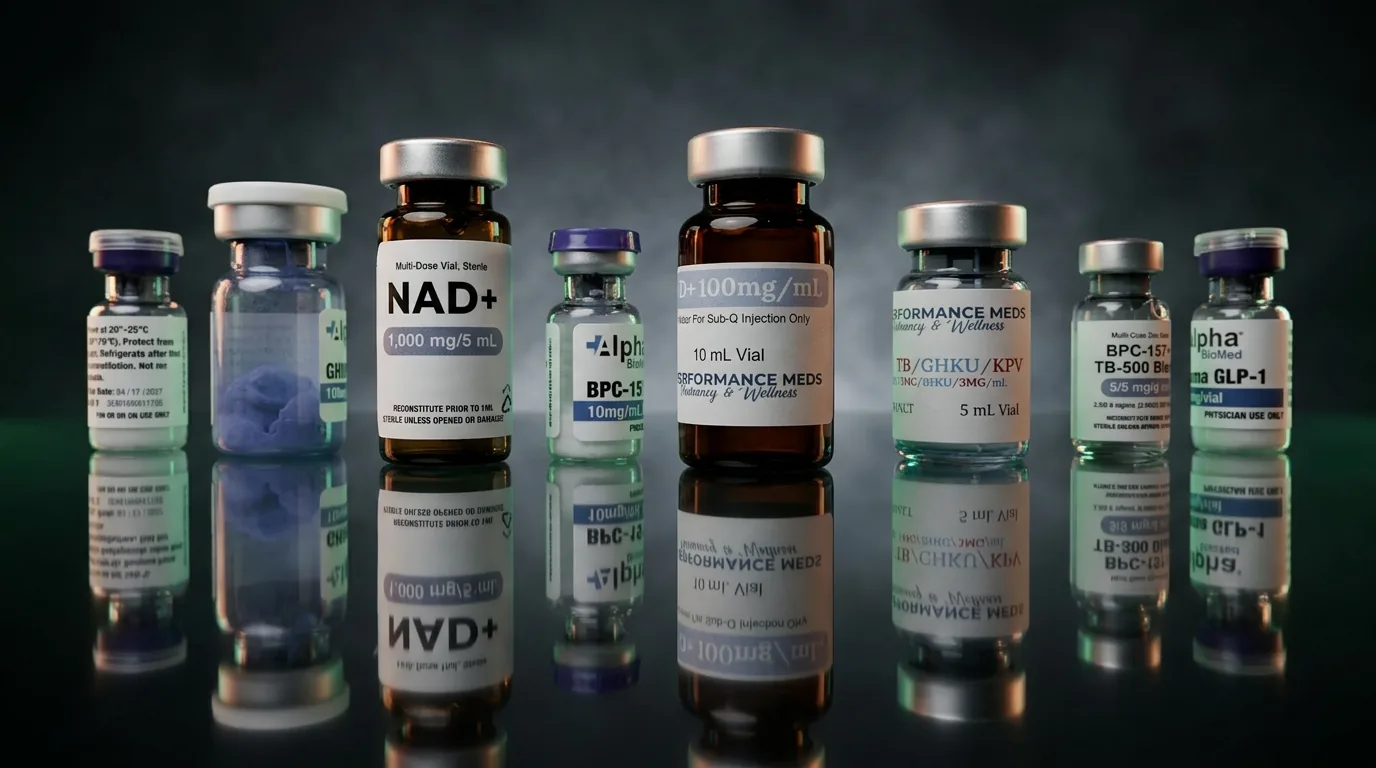
Products labeled for laboratory use only are not approved for human administration, and purity, sterility and dosing accuracy can't be reliably confirmed.
The goals peptides are commonly discussed for
Research is ongoing and responses vary by individual. In medical settings, peptides come up inside broader wellness strategies — not as standalone cures.
Metabolic & body composition
Metabolic support
Studied for their potential role in supporting lean muscle, metabolic function and recovery alongside nutrition, training and sleep. Notably, GLP-1 medications such as semaglutide are technically peptides.
Explore GLP-1 OptionsHealthy aging & longevity
Longevity protocols
Discussed within longevity-focused care models, often alongside therapies such as NAD+ or B12 as part of a broader medical wellness approach.
See Longevity PeptidesRecovery & performance
Tissue repair & recovery
Evaluated in regenerative and performance-focused care for their potential to support tissue repair. These conversations require careful screening first.
View The Glow StackFocus, mood & skin
Cognitive & aesthetic
Some peptides are discussed for focus, stress resilience, skin quality and hair — usually as a complement to a hormone plan rather than a replacement for one.
Browse The Full MenuSignaling peptides
Short amino-acid chains that act as messengers — telling cells to repair, release hormones, build muscle, or modulate inflammation. This is what most clinicians mean when they say “peptide therapy.”
Coenzymes
Cofactors that fuel cellular machinery. Not made of amino-acid chains, so technically not peptides — but commonly stacked alongside them in longevity and metabolic protocols.
Antioxidants
Molecules whose primary job is neutralizing oxidative stress and supporting detoxification. Some (like glutathione) are technically peptides by structure, but they don't act as signaling peptides.
Lipotropic blends
Vitamin and amino-acid blends used to support fat metabolism and liver function. Not peptides — included here because they're commonly stacked with metabolic protocols.
Sourcing is the whole conversation
The biggest risk in this space isn't the molecule — it's the marketplace. Products sold online as “research peptides” are typically not approved for human use and aren't held to the quality standards of a prescribed medication.
In a clinical setting, purity, sterility and dosing accuracy are traceable. Outside one, they simply can't be confirmed.
Regulated sourcing
Peptides are sourced from licensed, regulated compounding pharmacies or pharmaceutical manufacturers — never grey-market research vials.
Screening before dosing
Patients are screened for contraindications and medication interactions, and laboratory testing is used when it will actually guide the decision.
Provider-determined dosing
Dose, route and timing are determined by a qualified medical provider based on your history and goals — not copied from a forum thread.
Monitoring over time
Response and tolerance are monitored so the plan can be adjusted conservatively, prioritizing safety as much as effectiveness.
Who may be a good candidate
Likely candidates
- In overall good health and interested in proactive, medically guided wellness
- Willing to participate in structured monitoring and follow-up
- Comfortable with gradual progress rather than overnight change
- Values professional oversight over self-directed experimentation
When we say no
- Pregnant or breastfeeding
- Certain hormone-sensitive conditions
- Uncontrolled chronic medical issues
- Seeking unsupervised or performance-enhancing use

A real conversation comes first
We start with a detailed conversation about your health history, wellness priorities and current treatments to decide whether peptide therapy belongs in your plan at all. When it's indicated, laboratory testing guides responsible dosing.
Peptides also sit alongside the hormone work we're known for. For many women, hormone balance is the foundation and peptides are the layer on top — not a substitute.

Smaller than you're picturing
Most protocols use a very fine subcutaneous needle — the same type used for insulin — into the abdomen or thigh. Most members describe it as a pinch that's over before they've finished exhaling. Some peptides skip needles entirely as nasal sprays or topicals.
Peptide therapy questions
Where to go from here
Featured protocol
The Glow Stack
GHK-Cu, BPC-157 and TB-500 in one bundled protocol for skin, hair and tissue repair — reviewed by a clinician before it ships.
Explore The Glow StackTwo-minute assessment
Find my peptide match
Answer a few questions about energy, recovery, skin and goals, and see which protocol our clinicians would start you on.
Take The QuizBuild your own
The full peptide menu
Nine peptides across metabolism, recovery, focus, skin and longevity — browse the menu and build a protocol around your priorities.
Explore The MenuFind your peptide match in two minutes
Fourteen questions about how you actually feel — then a physician-reviewed protocol built around it.