A century-long story of accidental discoveries, Nobel Prizes, and quiet revolutions in molecular medicine — long before the wellness world caught on.
A century-long story of accidental discoveries, Nobel Prizes, and quiet revolutions in molecular medicine — long before the wellness world caught on.
What's covered
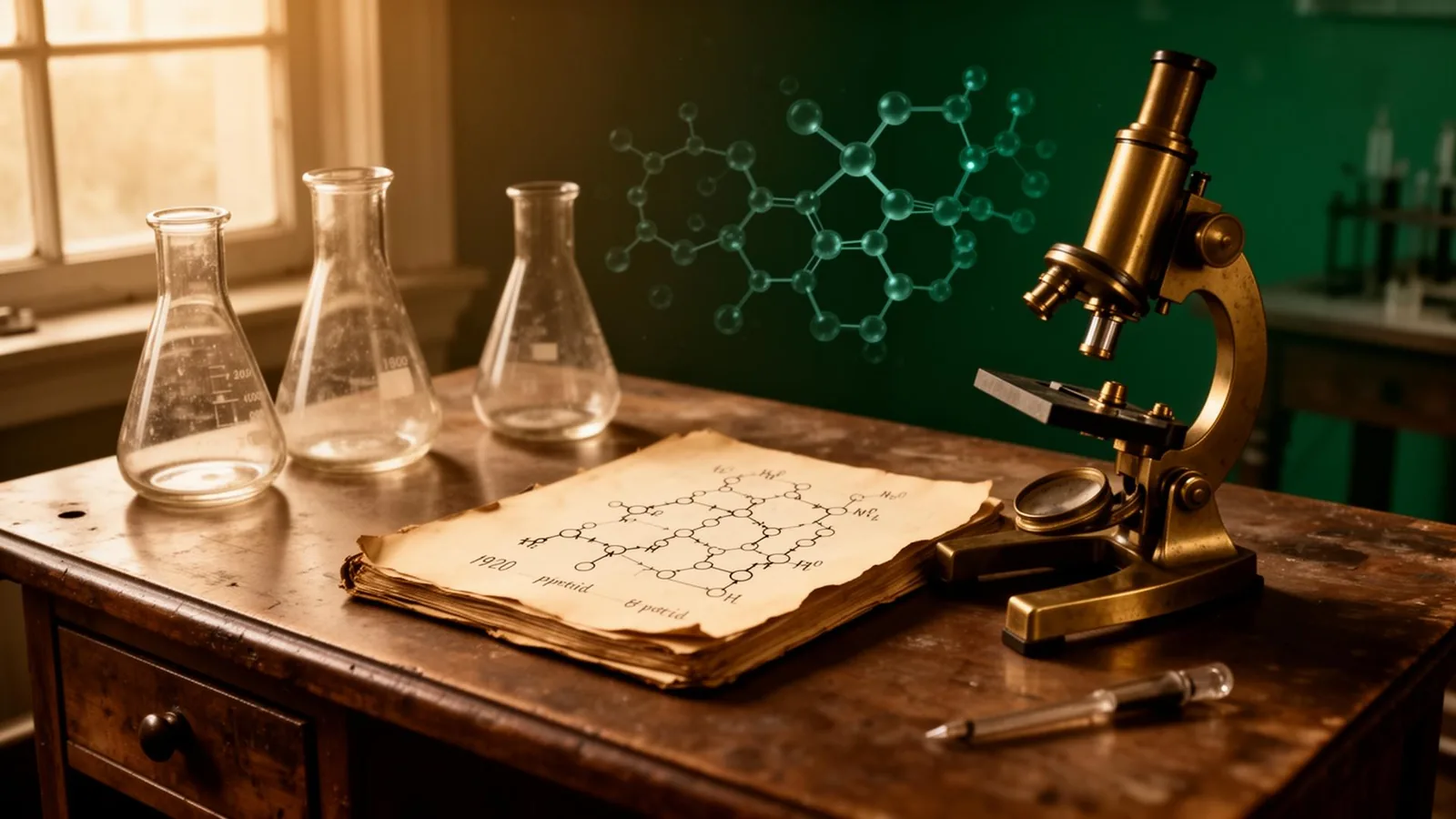
Walk into any modern wellness clinic in 2026 and you'll hear the word peptide used like it's the latest invention. It isn't. Peptides are older than antibiotics, older than the polio vaccine, older than the discovery of DNA's double helix. They are arguably the most important class of molecules in the history of medicine, and the story of how we found them, named them, synthesized them, and finally handed them to ordinary people is one of the great quiet epics of science.
This is that story. Not the marketing version — the real one, with the Nobel Prizes, the dying boys, the lab accidents, and the bureaucratic graveyard where good molecules go to wait their turn.
- The very first hormone ever discovered — secretin, in 1902 — was a peptide.
- Insulin, a 51-amino-acid peptide, became the first peptide medicine in 1922.
- Five Nobel Prizes sit in the lineage of modern peptide therapy.
- What changed in the 2020s wasn't the science. It was access.
1902 — The discovery that hormones exist at all
Before 1902, biology had a problem. Scientists could see that the body coordinated itself across long distances — the pancreas knew when food arrived, the adrenals knew when danger appeared — but no one could explain how. The leading theory was nervous control: every signal, they assumed, traveled through nerves.
Two British physiologists at University College London, William Bayliss and Ernest Starling, suspected something else was going on. They cut every nerve to a section of dog intestine, then introduced acidic food into it. The pancreas still secreted digestive juice, on cue, even with no nervous connection at all. Something chemical, blood-borne, and stunningly fast was carrying the message.
They isolated the substance, named it secretin, and in doing so invented the entire concept of hormonal signaling. Three years later, Starling coined the word hormone — Greek for “to set in motion.” Secretin is a 27-amino-acid peptide. The first hormone ever discovered was a peptide. Modern endocrinology was born from a peptide. Almost everyone forgets this.
1921 — The Toronto miracle
Type 1 diabetes was a death sentence. Children diagnosed with it lived six months, maybe a year, on starvation diets that bought them time the way a tourniquet buys a soldier time. The pancreas of these children had stopped producing a mysterious substance everyone knew existed but no one had been able to extract.
In the summer of 1921, a young Canadian surgeon named Frederick Banting — broke, recently jilted, working unpaid in a borrowed lab at the University of Toronto — convinced a senior physiologist, J.J.R. Macleod, to give him a basement, a medical student named Charles Best, and ten dogs. Banting's idea was crude but brilliant: tie off the pancreatic duct, let the digestive tissue degenerate, and extract what was left. What was left was insulin.
By January 1922 they had purified enough to inject a 14-year-old boy named Leonard Thompson, weighing 65 pounds and days from death at Toronto General Hospital. The first batch was impure and triggered an allergic reaction. The second batch, 12 days later, worked. Within hours his blood sugar fell. Within days he was eating again. He lived another 13 years.
Banting and Macleod won the Nobel Prize in 1923 — the fastest Nobel ever awarded for a medical discovery. Insulin is a 51-amino-acid peptide hormone. It became the first peptide medicine, and within two years Eli Lilly was manufacturing it at industrial scale and selling it for pennies. An entire pharmaceutical industry was bootstrapped by a peptide.
1953 — Sanger reads insulin like a sentence
By the 1940s, scientists knew insulin worked. They had no idea what it actually was. The prevailing assumption was that proteins were sloppy, repetitive structures. A young, intensely shy chemist at Cambridge named Frederick Sanger decided to test the assumption.
He spent twelve years on insulin — cleaving the molecule with acid, separating fragments on paper chromatograms, sequencing them by hand, reassembling the puzzle. In 1953 he published the complete amino-acid sequence of bovine insulin. It was the first time anyone had read the sequence of a protein, and it proved proteins are precise, ordered, information-carrying molecules.
Sanger won his first Nobel in 1958, then turned the same patient logic onto DNA and won a second in 1980. Every modern molecular tool descends from a man trying to figure out what insulin actually looked like. The peptide came first.
1963 — The bead that changed everything
Knowing the structure of a peptide and being able to make one are very different problems. Through the 1950s, synthesizing even a small peptide was a heroic chemistry project that took months and produced milligrams. Then Bruce Merrifield, a young biochemist at Rockefeller University, had a quiet, weird idea.
What if you anchored the first amino acid to a tiny insoluble polystyrene bead, then added each successive amino acid one at a time, washing the byproducts away between cycles? He called it solid-phase peptide synthesis. His colleagues thought it would never work. It worked — and Merrifield won the Nobel in 1984. Every peptide in clinical use today exists because of a small bead in a Rockefeller lab in 1963.
1971–1977 — The hypothalamic gold rush
Two American researchers became obsessed with finding the brain peptides that control the pituitary — the master gland that runs growth, reproduction, stress, and metabolism. They were Roger Guillemin in California and Andrew Schally in New Orleans, and they hated each other.
Both men ground up millions of animal hypothalami to extract hormones present in nanograms per gland. They isolated TRH, GnRH, and somatostatin, and shared the 1977 Nobel Prize in Medicine. That work led directly to the growth-hormone-secretagogue family used in clinics today: sermorelin, tesamorelin, ipamorelin, CJC-1295.
1980s–1990s — The GLP-1 slow burn
In 1984, a Massachusetts General Hospital endocrinologist named Joel Habener identified a fragment of the proglucagon gene that powerfully lowered blood sugar. He called it glucagon-like peptide-1, or GLP-1. It had two problems: it was destroyed in the bloodstream within minutes, and it was a natural human peptide, which made it nearly impossible to patent. So pharma sat on it. For years.
In 1992, John Eng at the Bronx VA Hospital noticed that a peptide in the venom of the Gila monster looked structurally like GLP-1 but resisted breakdown for hours. That lizard peptide became exenatide, the first GLP-1 drug, approved in 2005. Novo Nordisk then engineered liraglutide (2010) and semaglutide (2017). Eli Lilly answered with tirzepatide in 2022.
From a 1984 academic paper to a $50-billion-a-year drug category took roughly forty years. The molecule didn't change. The patent strategy did.
Doctor-supervised semaglutide and tirzepatide programs at Hormone Bliss.
1991 — BPC-157 and the Croatian footnote
In a Zagreb laboratory in the early 1990s, a research group led by Predrag Sikiric was studying gastric juice — specifically, why the stomach can hold concentrated hydrochloric acid without digesting itself. They isolated a 15-amino-acid fragment of a protein called BPC (Body Protection Compound) and called it BPC-157.
What followed is one of the strangest publication trails in modern medicine: hundreds of peer-reviewed animal studies showing accelerated tendon healing, repaired gut lining, and modulation of the gut-brain axis — almost entirely ignored by Western medicine for two decades, because a natural fragment of a human protein is essentially unpatentable.
2020s — The convergence
Three forces collided in the early 2020s and turned a century-old field into a consumer category. First, Ozempic: once tens of millions of ordinary people watched relatives lose 40 pounds on a weekly peptide injection, the cultural fear of needles evaporated.
Second, telehealth. After 2020, remote prescribing loosened and compounding pharmacies expanded into direct-to-patient fulfillment. Third, the podcast economy — peptides became dinner-table conversation instead of the private vocabulary of NFL trainers and hormone clinics.
Why the timeline matters
When someone calls peptides a trend, what they're describing is the marketing layer. Underneath it is the longest, most carefully studied, most Nobel-decorated class of molecules in modern medicine. Insulin saved children in 1922. Semaglutide is reshaping the obesity epidemic in 2026.
Peptides aren't a fad. They're a hundred-year-old conversation between biology and chemistry, finally loud enough for the rest of us to hear.
A short assessment matches you to a physician-reviewed peptide protocol.
Medical Disclaimer: This article is educational and is not medical advice. Peptide therapy requires evaluation by a licensed clinician and appropriate lab work.