
Peptides Explained
What peptides are, and how they actually work
No hype and no biohacker vocabulary. Start with the biology: what peptides are, how they signal your cells, the goals they're studied for, and where the honest limits of the research sit.
Educational only — the peptides discussed here require a prescription and clinical supervision.
Short chains that carry instructions
Peptides are short chains of amino acids — the same building blocks your body uses to make proteins. Many act as signaling molecules, which is a technical way of saying they help cells communicate.
Through that signaling, peptides can influence processes such as metabolism, tissue repair, hormone activity and inflammation. Peptide therapy simply means using specific peptides under medical supervision to support those functions.
Browse The Peptide LibraryPeptides are best viewed as supportive tools that may influence specific biological pathways — when used appropriately, inside a structured medical program.
Not a trend — a hundred-year-old class of medicine
The first hormone ever discovered — secretin, in 1902 — was a peptide. So was insulin, the first peptide medicine, prescribed since 1922. Five Nobel Prizes sit in this lineage.
What changed recently isn't the science; it's access — compounding pharmacies, telehealth and clinicians willing to read the literature.
One message, four steps
The mechanism is simpler than the marketing makes it sound. Here's the whole arc, from molecule to follow-up.
Step one
A short chain of amino acids
Amino acids are the building blocks of proteins. String a handful together — far shorter than a full protein — and you have a peptide. Your body already makes hundreds of them.
Step two
It delivers a message to a receptor
Most therapeutic peptides act as signaling molecules: they bind to a receptor on a cell and hand over an instruction. Repair this tissue. Release growth hormone tonight. Calm this inflammation.
Step three
The cell responds through its own pathways
The cell does the work, using processes that already exist. That's why appropriately dosed peptides tend to stay within a physiologic range rather than overwhelming a system.
Step four
Response is measured, then adjusted
Peptide use is not a single decision. Follow-up evaluates how a person actually responded so dosing can be adjusted, cycled, paused or stopped.
Explore Peptide Therapy
What peptide therapy is not
Hormone therapy restores a hormone your body has stopped making. Most peptides prompt your body to act for itself — which is exactly why the honest version of this conversation includes limits.
Not a shortcut to rapid transformation
Changes are gradual and depend on the peptide, your physiology and the goal. Anyone promising a dramatic result in days is selling something else.
Not one universal protocol
There is no single stack that works the same way for everyone. Selection is a clinical judgment call, not a trend.
Not the same as “research peptides”
Products labeled for laboratory use only are not approved for human administration, and purity, sterility and dosing accuracy can't be reliably confirmed.
One category. Six very different jobs.
Peptides are messengers. Which message gets sent depends entirely on which molecule is chosen — and that is a clinical decision, not a shopping decision.
Energy & longevity
NAD+ and MOTS-c are studied at the mitochondria — the machinery that decides how much usable energy a cell can produce.
Recovery & repair
BPC-157, TB-500 and sermorelin appear in the literature on connective tissue repair, sleep quality and recovery capacity.
Metabolism
AOD-9604, MOTS-c and lipotropic blends are discussed for fat metabolism and insulin sensitivity. GLP-1 medications are technically peptides too.
Skin, hair & glow
GHK-Cu and glutathione are examined for collagen signaling, skin tone and follicle support.
Focus & mood
Semax and Selank are studied for attention, stress resilience and neuroprotection — usually alongside a hormone plan, not instead of one.
Detox & antioxidant
Glutathione is the body's master antioxidant, central to liver detoxification and oxidative-stress handling.
Signaling peptides
Short amino-acid chains that act as messengers — telling cells to repair, release hormones, build muscle, or modulate inflammation. This is what most clinicians mean when they say “peptide therapy.”
Coenzymes
Cofactors that fuel cellular machinery. Not made of amino-acid chains, so technically not peptides — but commonly stacked alongside them in longevity and metabolic protocols.
Antioxidants
Molecules whose primary job is neutralizing oxidative stress and supporting detoxification. Some (like glutathione) are technically peptides by structure, but they don't act as signaling peptides.
Lipotropic blends
Vitamin and amino-acid blends used to support fat metabolism and liver function. Not peptides — included here because they're commonly stacked with metabolic protocols.
Learn before you decide
One in-depth educational guide per peptide: what it is, how it's thought to work, who explores it, and what the research honestly supports — caveats included.
BPC-157
Tissue repair and gut lining
An educational guide to BPC-157 — what the peptide is, how it is thought to work, who explores it, what research exists, and how it fits clinical care.
Learn MoreTB-500
Cell migration and whole-body repair
An educational guide to TB-500 (thymosin beta-4) — what it is, the mechanisms studied, who explores it, the state of the research, and clinical context.
Learn MoreSermorelin
Growth hormone releasing hormone analog
An educational guide to sermorelin — a growth hormone releasing hormone analog. What it is, how it differs from HGH, the research, and clinical context.
Learn MoreAOD-9604
A growth hormone fragment studied for fat metabolism
An educational guide to AOD-9604 — the growth hormone fragment studied for fat metabolism. Mechanism, honest research summary and clinical context.
Learn MoreLipo-B
A lipotropic vitamin and amino acid injection
An educational guide to Lipo-B lipotropic injections — the ingredients, what they do metabolically, realistic expectations and clinical context.
Learn MoreMOTS-C
A mitochondrial-derived peptide
An educational guide to MOTS-C — a mitochondrial-derived peptide studied for metabolic flexibility, insulin sensitivity and exercise capacity.
Learn MoreNAD+
The coenzyme behind cellular energy
An educational guide to NAD+ — the coenzyme central to cellular energy and DNA repair. What it is, why it declines, and what the research supports.
Learn MoreGlutathione
The body's master antioxidant
An educational guide to glutathione — the body's master antioxidant. What it does, why levels fall, delivery routes and what the evidence supports.
Learn MoreGHK-Cu
The copper peptide for skin and repair
An educational guide to GHK-Cu — the copper-binding peptide studied for collagen, skin remodelling and wound repair. Mechanism, research and context.
Learn MoreSemax / Selank
Nootropic peptides for focus and stress
An educational guide to Semax and Selank — nasal nootropic peptides studied for focus, neuroprotection and anxiety. Mechanisms, research and context.
Learn More
Why certain peptides are commonly paired
These are the pairings we're asked about most — explanations, not prescriptions. Understanding why two peptides complement each other is more useful than copying a stack.
Repair & rebuild
Sermorelin + BPC-157 / TB-500
Growth-hormone signaling paired with soft-tissue repair — the pairing asked about most in recovery contexts.
Cellular energy
NAD+ + MOTS-C
Mitochondrial support approached from two directions, for fatigue that sleep alone hasn't resolved.
Skin clarity
GHK-Cu + Glutathione
Collagen signaling alongside antioxidant support for tone and texture.
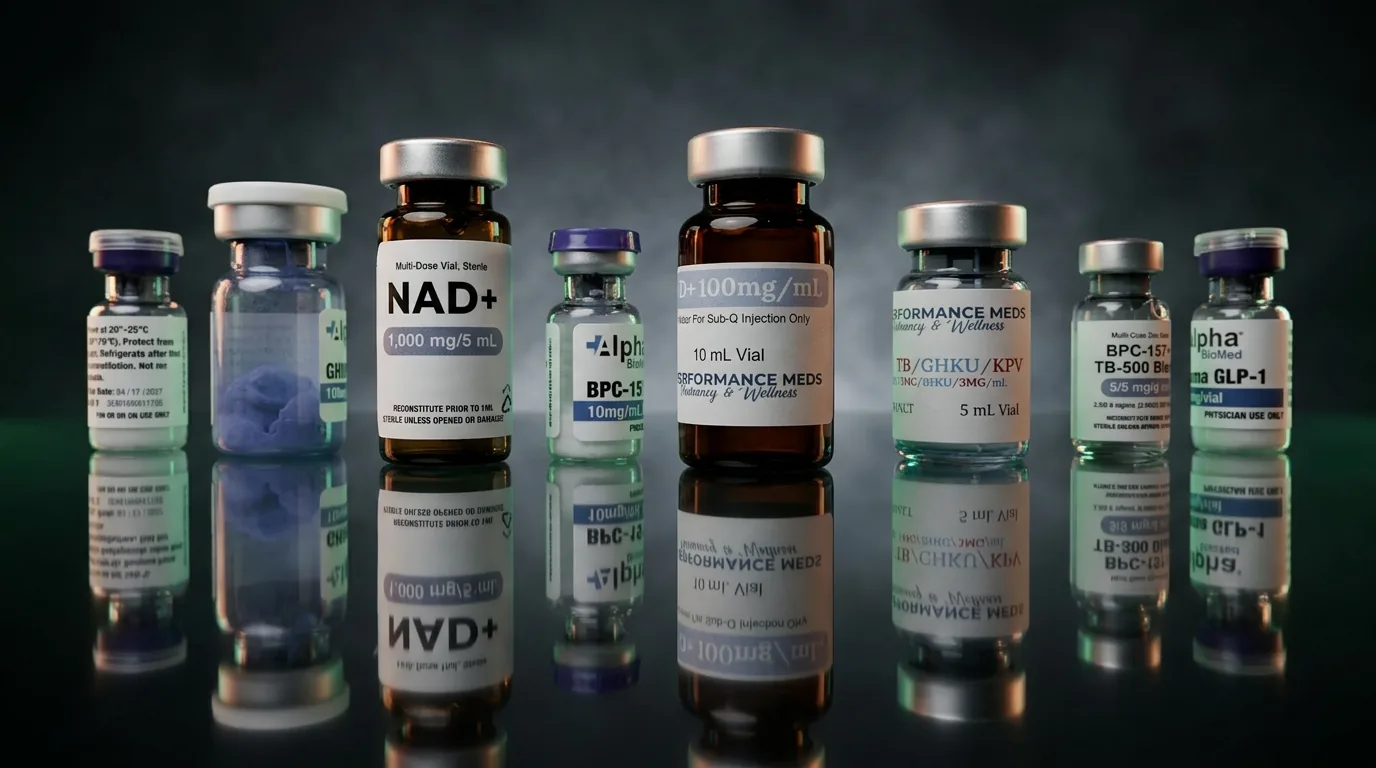
Sourcing is the whole conversation
The biggest risk in this space isn't the molecule — it's the marketplace. Products sold online as “research peptides” are typically not approved for human use and aren't held to the quality standards of a prescribed medication.
In a clinical setting, purity, sterility and dosing accuracy are traceable. Outside one, they simply can't be confirmed.
Regulated sourcing
Prescribed peptides come from licensed compounding pharmacies or pharmaceutical manufacturers where potency and sterility are traceable.
Screening before dosing
Contraindications, current medications and appropriateness are assessed first. Sometimes the honest answer is that peptides aren't indicated.
Provider-determined dosing
Dose, route and timing are clinical decisions based on history and goals — not copied from a forum thread.
Monitoring over time
Response and tolerance are tracked so plans can be adjusted conservatively, prioritizing safety alongside effect.
Who may be a good candidate
Likely candidates
- In overall good health and interested in proactive, medically guided wellness
- Willing to participate in structured monitoring and follow-up
- Comfortable with gradual progress rather than overnight change
- Values professional oversight over self-directed experimentation
When the answer is no
- Pregnant or breastfeeding
- Certain hormone-sensitive conditions
- Uncontrolled chronic medical issues
- Seeking unsupervised or performance-enhancing use

Smaller than people expect
Most peptides are given subcutaneously with a very fine insulin-style needle — thinner than the ones used for blood draws. Many people describe finishing before they've finished exhaling. Some peptides skip needles entirely as nasal sprays or topicals.
Administration details, dosing and cycling are decided with a clinician. That side of the conversation lives on our peptide therapy program page.
Where to go from here
Across the site
- Find your symptoms — start from what you're feeling rather than from a molecule.
- Hormones explained — the foundation peptides are usually layered on top of.
- HRT and BHRT explained — benefits, risks and what the research shows.
- GLP-1 and weight loss — GLP-1 medications are peptides too.
- Resources and downloads — guides and workbooks from Dr. Tammy.
- The blog — research explainers and peptide history.
Peptide questions
Ready to look at protocols instead of theory? See how peptide therapy works at Hormone Bliss.
Explore physician-guided peptide therapy
When you've read enough, see how peptide protocols work at Hormone Bliss — screening, sourcing, dosing and follow-up.