
The transition years
Perimenopause
The years before periods stop, when hormones fluctuate rather than simply decline. Symptoms can begin while cycles are still regular.
Learn About Perimenopause →Your body has a communication system. Hormones are the messages.
Sleep, mood, metabolism, temperature, memory, libido, bone strength — all of it runs on hormonal signaling. That's why one hormonal change is rarely felt in one place, and why symptoms that seem unrelated so often share a single cause.
This is our educational hub: what each hormone does, what happens when the signal changes, and which symptoms follow. Start anywhere.

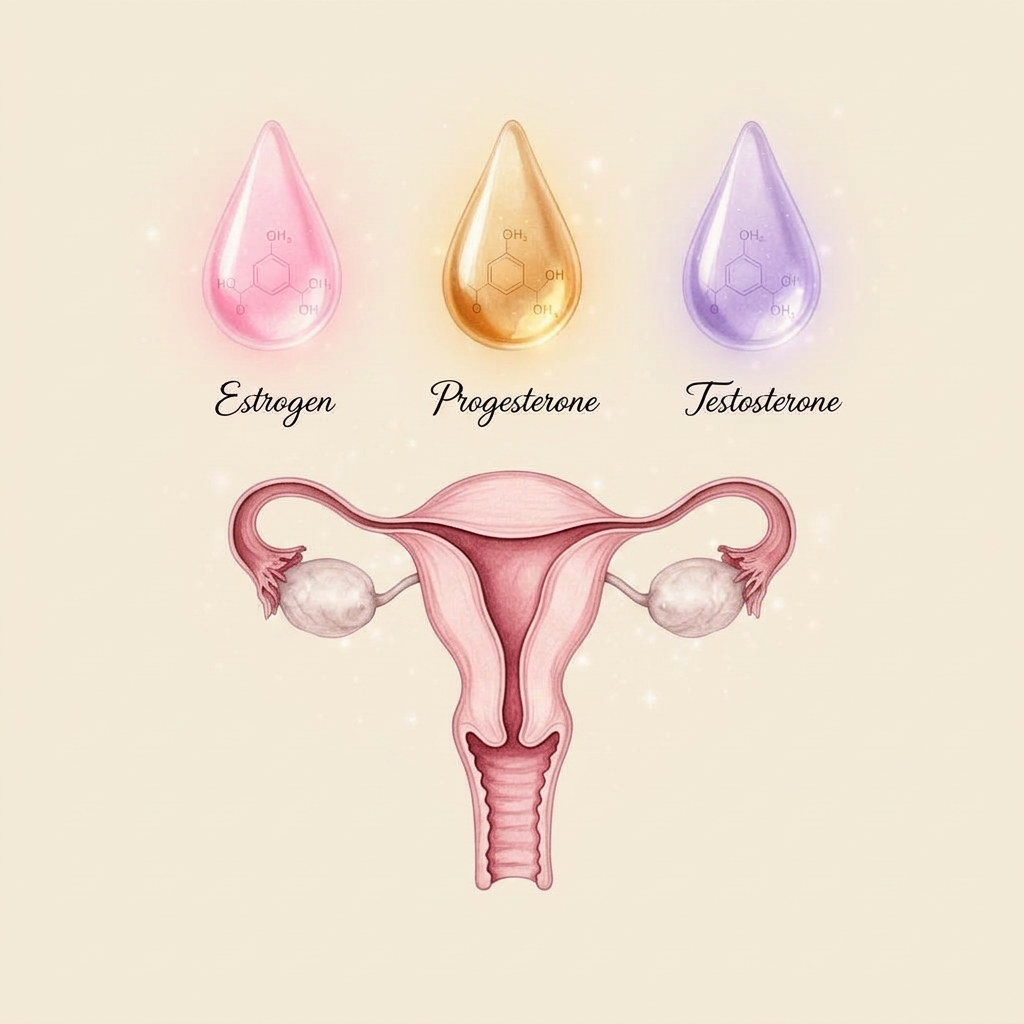
Hormones are chemical messengers. A gland releases one into the bloodstream, it travels to a distant tissue, and it binds to a receptor there — handing over an instruction. Release glucose. Cool down. Sleep. Build bone.
Because receptors for the same hormone sit in many different tissues, one message lands in several places at once. Estrogen speaks to the brain, bones, skin, blood vessels and bladder in the same breath.
Balance matters more than any single level. Hormones regulate each other through feedback loops, so what a lab value means depends on what everything around it is doing. That is why symptoms rarely exist in isolation — and why a list of symptoms is often more revealing than a single number.
Each one has its own job, its own rhythm and its own symptom signature. Each page below explains what it does, what low and high look like, and which symptoms follow.
The master regulator
Far more than a reproductive hormone — estrogen influences the brain, bones, skin, blood vessels and the body's temperature control.
Learn About EstrogenThe calming counterweight
Best known for pregnancy, but for most women its day-to-day value is sleep, calm and balancing estrogen's effect on the uterine lining.
Learn About ProgesteroneDrive, muscle and motivation
Women produce testosterone throughout life. It contributes to muscle, bone, energy, libido and the sense of get-up-and-go.
Learn About TestosteroneThe precursor hormone
Produced by the adrenal glands, DHEA is raw material the body converts into estrogen and testosterone as it needs them.
Learn About DHEAThe rhythm and stress hormone
Cortisol follows a daily curve — high in the morning, low at night. When the curve flattens or inverts, everything else follows.
Learn About CortisolThe metabolic pacesetter
Thyroid hormones set the speed of nearly every cell. Their symptoms overlap heavily with menopause, which is why both are checked.
Learn About ThyroidHormones don't only vary by molecule — they vary by decade. Knowing which stage you're in changes what your symptoms mean and what to do about them.
The transition years
The years before periods stop, when hormones fluctuate rather than simply decline. Symptoms can begin while cycles are still regular.
Learn About Perimenopause →The defining milestone
Technically a single day — twelve months after your final period. Hormonally, the point at which ovarian production has largely settled low.
Learn About Menopause →The longest stage
Hormones stabilize at a lower baseline. Attention shifts from fluctuation to long-term bone, heart, brain and tissue health.
Learn About Postmenopause →A hormonal and metabolic pattern
PCOS involves irregular ovulation, elevated androgens and, for many, insulin resistance — a metabolic condition as much as a reproductive one.
Learn About PCOS →A relationship, not a number
Estrogen dominance describes a ratio: estrogen that is high relative to progesterone — a pattern common in perimenopause.
Learn About Estrogen dominance →Hormone imbalance is rarely one broken part. It's usually several systems adjusting at once, which is why the same woman can have insomnia, weight gain and joint pain and be told they're unrelated.
Ovulation becomes less consistent from the late thirties onward. Progesterone falls first, estrogen fluctuates, and the change is felt long before periods stop.
Sustained demand alters the cortisol rhythm, and stress physiology competes with reproductive and thyroid signaling for the same resources.
Insulin resistance and changes in body composition alter how much estrogen the body makes from androgens — and how easily weight responds.
Sleep is when much of hormonal regulation happens. Poor sleep changes cortisol, appetite hormones and thyroid conversion within days.
Thyroid disease is more common in women and often surfaces in midlife, with a symptom picture almost identical to perimenopause.
The liver and gut clear hormones after they've done their job. When that pathway is stressed, hormone effects can linger longer than intended.
Symptoms overlap because hormones share tissues and regulate each other. Thyroid hormone, cortisol and estradiol all act on the brain. Estrogen and testosterone both act on bone. So the useful question is rarely which single hormone is wrong — it's what pattern do these symptoms make together.
Hormone therapy is the most studied and most misunderstood treatment in women's health. Our educational guide covers what HRT and BHRT are, which hormones are involved, the benefits, the risks, and what the research found once the 2002 headlines moved on.
It's written to be read before any decision is made — no program content, no pricing, no pressure.
Wondering what's available without a prescriber? Our guide to over-the-counter hormone creams explains how non-prescription topical estrogen, progesterone and DHEA creams differ from prescription hormone therapy, and how to choose a starting point.
Most women arrive with a symptom, not a hormone. Each page below explains what's driving it and which hormones are usually involved.

There is no single right program. What fits depends on your symptoms, your labs, your history and your goals — which is why every path at Hormone Bliss starts with an assessment rather than a product.
Bioidentical hormone care
Non-prescription bioidentical hormone-support creams with individualized routines and ongoing coaching — for women whose symptoms point to hormone imbalance.
Explore Hormone Replacement TherapyMetabolic support
Medically supervised GLP-1 therapy for women whose primary obstacle is metabolic — stubborn weight, insulin resistance and appetite signaling.
Explore GLP-1 & Weight LossCellular signaling
Prescription peptides used alongside a hormone plan for recovery, energy, skin and longevity goals, always under medical oversight.
Explore Peptide TherapyWomen aren't confused about their bodies. They've just never had the whole picture explained to them in one place.
A short, structured assessment built from the same questions our team asks — then a clear next step.