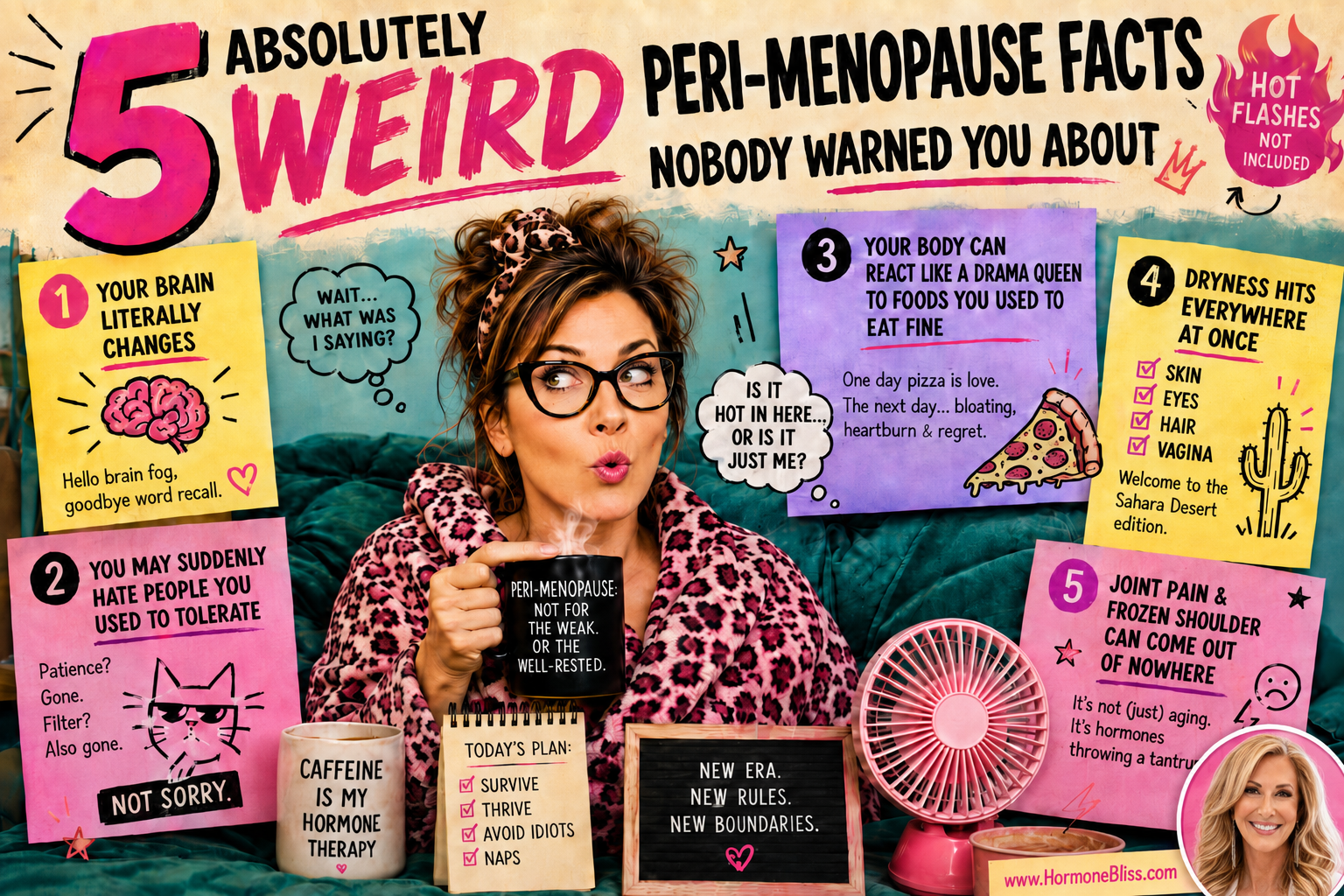

Hot flashes get all the attention. But brain fog, sudden irritability, new food reactions, dryness everywhere, and a frozen shoulder out of nowhere are just as real — and just as hormonal.
Hot flashes get all the attention. But brain fog, sudden irritability, new food reactions, dryness everywhere, and a frozen shoulder out of nowhere are just as real — and just as hormonal.
What's covered
- Quick Answer: What Are Some Weird Symptoms of Perimenopause?
- 1. Your Brain May Feel Different
- 2. You May Suddenly Have Less Patience for Everyone
- 3. Foods You Used to Love May Suddenly Fight Back
- 4. Dryness Can Show Up Almost Everywhere
- 5. Joint Pain or Frozen Shoulder May Appear Out of Nowhere
- How Do You Know If These Symptoms Are Perimenopause?
- What Can Help With Weird Perimenopause Symptoms?
When most women hear the word perimenopause, they think of hot flashes and missed periods.
That is the cute little brochure version.
In real life, perimenopause can look like forgetting familiar words, becoming irrationally annoyed by the sound of someone chewing, feeling bloated after foods you have eaten for years, drying out from head to toe, or waking up with a shoulder that suddenly refuses to cooperate.
Welcome to the hormonal plot twist nobody properly explained.
Perimenopause is the transition leading up to menopause. During this time, the ovaries do not simply stop producing hormones overnight. Estrogen and progesterone can rise, fall, and fluctuate unpredictably.
Think of it like a thermostat with a loose wire. Some days it works. Other days, the whole house feels possessed.
These hormonal shifts can affect much more than your menstrual cycle. They can influence the brain, mood, digestive system, skin, vaginal tissue, muscles, and joints.
Here are five weird perimenopause symptoms women are often never warned about.
Quick Answer: What Are Some Weird Symptoms of Perimenopause?
Unexpected symptoms of perimenopause may include:
- Brain fog and difficulty finding words
- New irritability or less tolerance for stress
- Bloating, heartburn, or changing reactions to food
- Dry eyes, skin, hair, mouth, or vaginal tissue
- Joint pain, stiffness, or frozen shoulder
These symptoms can be related to hormonal changes, but they can also have other causes. Thyroid disorders, anemia, nutrient deficiencies, autoimmune disease, medication effects, sleep problems, and other medical conditions may produce similar symptoms.
That is why women deserve an actual evaluation, not a shrug and a prescription for "stress."
1. Your Brain May Feel Different
Have you ever walked into a room and forgotten why you went there?
Do familiar words suddenly disappear in the middle of a sentence?
Maybe you are staring at someone you have known for years while your brain frantically searches for her name.
You are not imagining it.
Between 40% and 60% of midlife women report cognitive symptoms during the menopause transition. These may include forgetfulness, difficulty concentrating, distractibility, and trouble recalling words or names, according to The Menopause Society.
Estrogen interacts with brain systems involved in memory, attention, mood, and temperature regulation. Hormonal fluctuations may contribute to that foggy, mentally overloaded feeling.
Poor sleep can make it even worse. If night sweats, anxiety, or insomnia are repeatedly waking you, your brain is trying to function with its battery sitting at 12%.
The reassuring news is that ordinary perimenopause brain fog is usually mild and is not automatically a sign of dementia.
However, sudden confusion, slurred speech, facial drooping, severe headache, weakness, or one-sided numbness requires immediate medical attention.
2. You May Suddenly Have Less Patience for Everyone
You used to tolerate the meeting that should have been an email.
Now you are one loud chewer away from moving into the woods.
Perimenopause can bring increased irritability, anxiety, emotional sensitivity, or a lower tolerance for stress. It does not necessarily mean that your personality has changed. It may mean that the hormonal support system helping regulate your mood is becoming less predictable.
Hormone fluctuations can interact with brain chemicals involved in emotional regulation. Sleep disruption, blood sugar swings, caregiving demands, work stress, and feeling physically miserable can pile on quickly.
In other words, it may not be "just hormones," but hormones can lower the drawbridge and let everything else charge into the castle.
Depression and anxiety should never be dismissed as something women simply have to endure. The menopause transition is a recognized period of increased vulnerability to mood symptoms, particularly in women with a previous history of depression.
Seek prompt help if mood changes are severe, interfere with daily life, or include hopelessness, panic, or thoughts of self-harm.
3. Foods You Used to Love May Suddenly Fight Back
Yesterday, pizza was your soulmate.
Today, it brought bloating, reflux, and regret.
Many women report digestive changes during midlife, including increased bloating, constipation, diarrhea, heartburn, or abdominal discomfort. Hormones may influence gut movement, pain sensitivity, stress responses, and the gut microbiome.
However, this is where we need to be honest. The relationship between perimenopause and gastrointestinal symptoms is still being studied. Current research suggests a possible connection, but it is not strong enough to declare every new digestive problem a hormone problem.
Stress, poor sleep, medications, gallbladder disease, irritable bowel syndrome, celiac disease, food intolerance, and other medical conditions may also be responsible.
Try keeping a simple food and symptom journal. Record what you ate, when symptoms started, bowel changes, sleep quality, cycle timing, and stress level. Patterns are much more useful than randomly eliminating half the grocery store.
Persistent abdominal pain, vomiting, black or bloody stools, trouble swallowing, unexplained weight loss, or a major change in bowel habits should be medically evaluated.
4. Dryness Can Show Up Almost Everywhere
Perimenopause can feel like someone quietly turned off the body's moisture setting.
Women may notice:
- Drier or itchier skin
- Dry, irritated eyes
- Brittle or changing hair
- Dry mouth
- Vaginal dryness, burning, or discomfort with sex
Estrogen helps support collagen, skin thickness, circulation, and moisture in several tissues. As estrogen declines, the skin may become thinner and drier. The National Institute on Aging also recognizes skin dryness and musculoskeletal changes as possible effects of menopause.
Changing hormone levels can affect the oil glands around the eyes, which may contribute to dry-eye symptoms, according to the American Academy of Ophthalmology.
Vaginal dryness is especially important because it often gets worse without treatment. Declining estrogen may make vaginal and vulvar tissue thinner, drier, and less elastic. This can cause burning, irritation, urinary symptoms, recurrent infections, or pain during sex.
This collection of symptoms is called genitourinary syndrome of menopause, or GSM.
Please do not accept "use more lubricant" as the entire conversation. Moisturizers and lubricants can help, but prescription treatments are also available. The right option depends on your symptoms, medical history, and personal risk factors.
5. Joint Pain or Frozen Shoulder May Appear Out of Nowhere
You did not fall.
You did not join a competitive weightlifting team.
Yet your shoulder suddenly hurts, your hips feel stiff, or your hands ache when you wake up.
Estrogen has effects on muscles, tendons, cartilage, bone, and inflammatory pathways. Hormonal changes may contribute to joint stiffness, muscle discomfort, and slower recovery during the menopause transition.
Researchers have described a possible "musculoskeletal syndrome of menopause" that includes joint pain, loss of muscle mass, reduced bone density, tendon problems, and frozen shoulder. However, research into the direct relationship between hormone therapy and frozen shoulder is still developing.
A recent pilot study found that frozen shoulder occurred less often among women using systemic estrogen, but the difference was not statistically significant. That means the finding is interesting, not proof.
Joint pain still deserves an appropriate evaluation. Osteoarthritis, thyroid disease, autoimmune conditions, diabetes, injury, and nutrient deficiencies may cause similar symptoms.
If a shoulder becomes increasingly painful or difficult to move, get it checked early. Frozen shoulder can become significantly harder to treat once movement is severely restricted.
How Do You Know If These Symptoms Are Perimenopause?
Perimenopause usually begins in the forties, although symptoms can start earlier. It may last for several years before the final menstrual period.
Clues may include changing cycle length, heavier or lighter bleeding, skipped periods, hot flashes, night sweats, disrupted sleep, mood changes, vaginal dryness, or new symptoms that seem to follow a cycle-related pattern.
There is no single blood, saliva, or urine test that can diagnose every case of perimenopause. Hormone levels can fluctuate dramatically from one day to the next.
Testing can still be useful when selected and interpreted correctly. It may help evaluate hormone patterns, thyroid function, anemia, blood sugar, nutrient deficiencies, or other conditions that can imitate or worsen perimenopause symptoms.
The value is not simply collecting numbers. The value is connecting your symptoms, history, cycle pattern, medical risks, and appropriate testing into one clear plan.
What Can Help With Weird Perimenopause Symptoms?
Treatment depends on what is driving the symptoms and how much they are affecting your quality of life.
Options may include improving sleep, resistance training, nutrition support, treating vaginal dryness, addressing thyroid or nutrient problems, nonhormonal medications, or considering menopausal hormone therapy when appropriate.
Hormone therapy can be very effective for hot flashes and night sweats, but it is not a magic eraser for every symptom. Its benefits and risks must be evaluated for each woman. Your age, uterus status, bleeding history, migraine history, blood-clot risk, cardiovascular health, and cancer history all matter.
That is called personalized medicine.
It should also be called common sense.
You Deserve More Than "Everything Looks Normal"
If you feel different but keep being told that your labs are "normal," the problem may not be a lack of symptoms.
The problem may be that nobody has taken the time to connect the dots.
Hormone Bliss gives women access to convenient, at-home hormone support without spending months trying to convince someone that their symptoms are real.
Our program offers optional at-home educational testing, a non-prescription bioidentical hormone-support cream, an educational app, and hormone health coach support — shipped directly to your door. If you are looking for prescription hormone therapy, that is a conversation for your own licensed healthcare professional.
No monthly pharmacy lines. No guessing alone. No being handed a one-size-fits-all answer and shown the exit.
Your symptoms are information.
Let's start listening.
Ready to learn whether Hormone Bliss may be right for you? Take the first step toward feeling like yourself again.
Frequently Asked Questions About Perimenopause
Medical Disclaimer: This content is educational and is not medical advice. It does not replace a personal evaluation with your provider.