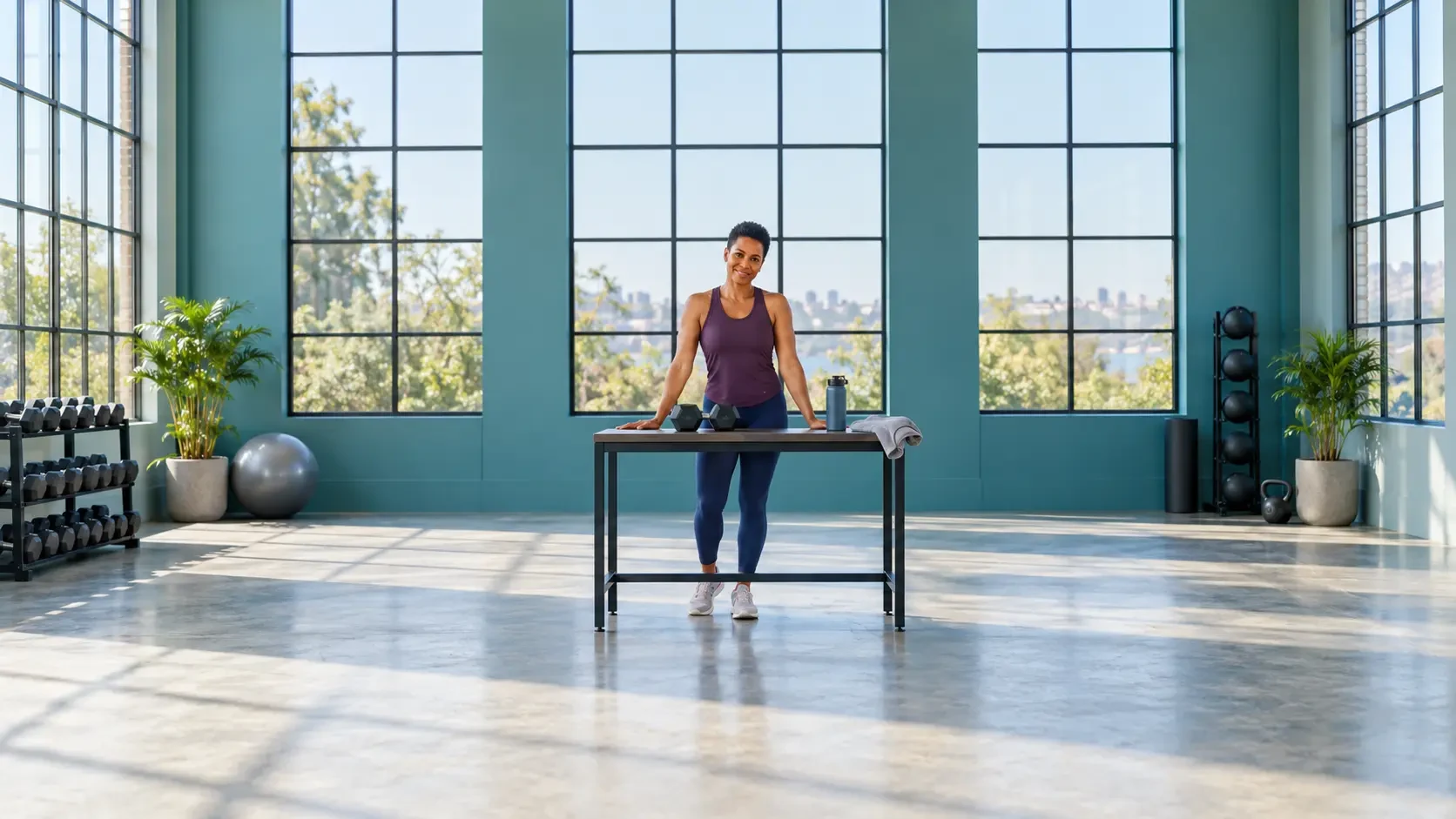

Walking is valuable, but your muscles need a different challenge. Learn how to add realistic strength work in midlife—without chasing the scale.
If you walk regularly but carrying groceries still feels harder than it used to, you have not failed at exercise. Your routine may simply be missing a different kind of work.
Walking matters. So does asking your muscles to push, pull, lift, and carry. In perimenopause and menopause, the conversation does not need to be another lecture about shrinking your body. Let’s talk about making daily life feel more capable.
Walking and strength work are teammates
Brisk walking is aerobic activity: it gets your heart beating faster and your breathing working harder. Resistance exercise challenges muscles against a load. That load might be a weight, a band, or your own body. Both belong in a well-rounded routine; one does not make the other pointless. [1]
The general adult activity goal includes at least 150 minutes of moderate aerobic activity each week, plus muscle-strengthening activity on two or more days. Strength work should involve the major muscle groups. These are goals to build toward, not an entrance exam you have to pass before starting. Some activity is better than none. [1,2]
Why this deserves a place in your midlife plan
Muscle strength supports ordinary freedoms: getting up from a chair, lifting a suitcase, carrying laundry, and climbing stairs. Muscle-strengthening activity can help maintain or increase muscle mass and strength as we age. [3]
Menopause is not a switch that makes training stop working. Research in menopausal women aged 40–60 supports exercise training as a way to improve muscle mass and strength compared with no exercise. The evidence does not mean everyone responds identically, and it does not promise a particular body size. [4]
Please retire the idea that a workout only counts when the scale rewards you. A steadier chair rise or a more comfortable grocery carry can be meaningful progress, too.
What actually counts as resistance training?
You do not need to love the weight room. Bands, body-weight movements, machines, and free weights can all provide resistance. Some yoga positions and demanding gardening tasks count as muscle-strengthening activities as well. The important detail is whether the activity meaningfully challenges the muscles you intend to train. [1]
A leisurely walk is valuable, but it usually does not challenge every major muscle group in the same way. Keep the walk. Add a strength plan rather than turning movement into a competition.
Build a starter plan you can repeat
Here is a planning framework—not a personalized workout prescription:
- 1
Choose two realistic calendar slots
Leave recovery time between demanding sessions for the same muscles.
- 2
Pick a setting you will actually use
home, a community class, or a gym.
- 3
Include a way to work the legs and hips, a push, a pull, and the trunk. A qualified instructor can help match movements to your ability.
- 4
Start with a manageable load and controlled technique
Make one change at a time as the work becomes easier.
- 5
Record what you did and how you felt afterward
Repetition beats a heroic first day followed by a two-week disappearance.
CDC describes a set as a group of repetitions and gives 8–12 repetitions as one practical example. That is a starting reference, not a mandate to grind through pain or lose control of a movement. Technique and the right level of challenge matter more than matching someone else’s dumbbell. [1]
Progress does not have to mean punishment
When an exercise becomes comfortably manageable with good form, you can consider a small increase in resistance, repetitions, or difficulty. Gradual increases are part of building strength. You do not have to increase everything at once. [3]
On a rough-sleep week, your plan may need adjusting. A shorter session or a lighter day is not a character flaw. The goal is a routine that can survive real life, not one that only works during an imaginary perfect week.
Keep the safety advice specific
New or worsening pain, dizziness, chest discomfort, or unusual breathlessness is not a challenge to push through. Stop the session and seek appropriate assessment; severe or sudden symptoms need urgent care. If you have osteoporosis, a recent fracture, a significant injury, or another condition that affects safe movement, get individualized guidance before choosing demanding exercises.
And if exhaustion or weakness has changed suddenly, do not assume you simply need a heavier workout. That deserves attention in its own right.
Where hormones fit—and where they do not
If hot flashes, poor sleep, or other menopause symptoms are making activity difficult, addressing those barriers belongs in your bigger plan. That is different from promising that hormones will build your muscles for you. This article is not a reason to start or change a hormone product, and strength training does not require every woman to use hormones.
Your first step can be wonderfully unglamorous: put two doable strength sessions on the calendar and decide what “getting more capable” would mean to you. Opening jars? Carrying the carry-on? Getting off the floor without an elaborate negotiation? Pick something that matters in your life.
At Hormone Bliss, we believe midlife support should start with listening—not a shrug and not another demand to try harder. Explore your symptoms and goals with our SymptomScan™ Analyzer, then use what you learn to decide what support you want next.
Frequently asked questions
Sources
- 1
CDC
What Counts as Physical Activity for Adults. December 6, 2023. https://www.cdc.gov/physical-activity-basics/adding-adults/what-counts.html
- 2
CDC
Adding Physical Activity as an Adult. May 15, 2024. https://www.cdc.gov/physical-activity-basics/adding-adults/index.html
- 3
CDC
Benefits of Physical Activity. December 4, 2025. https://www.cdc.gov/physical-activity-basics/benefits/index.html
- 4
Effect of non-pharmacological interventions on prevention of sarcopenia in menopausal women: systematic review and meta-analysis of randomized controlled trials. 2023. https://pmc.ncbi.nlm.nih.gov/articles/PMC10647115/